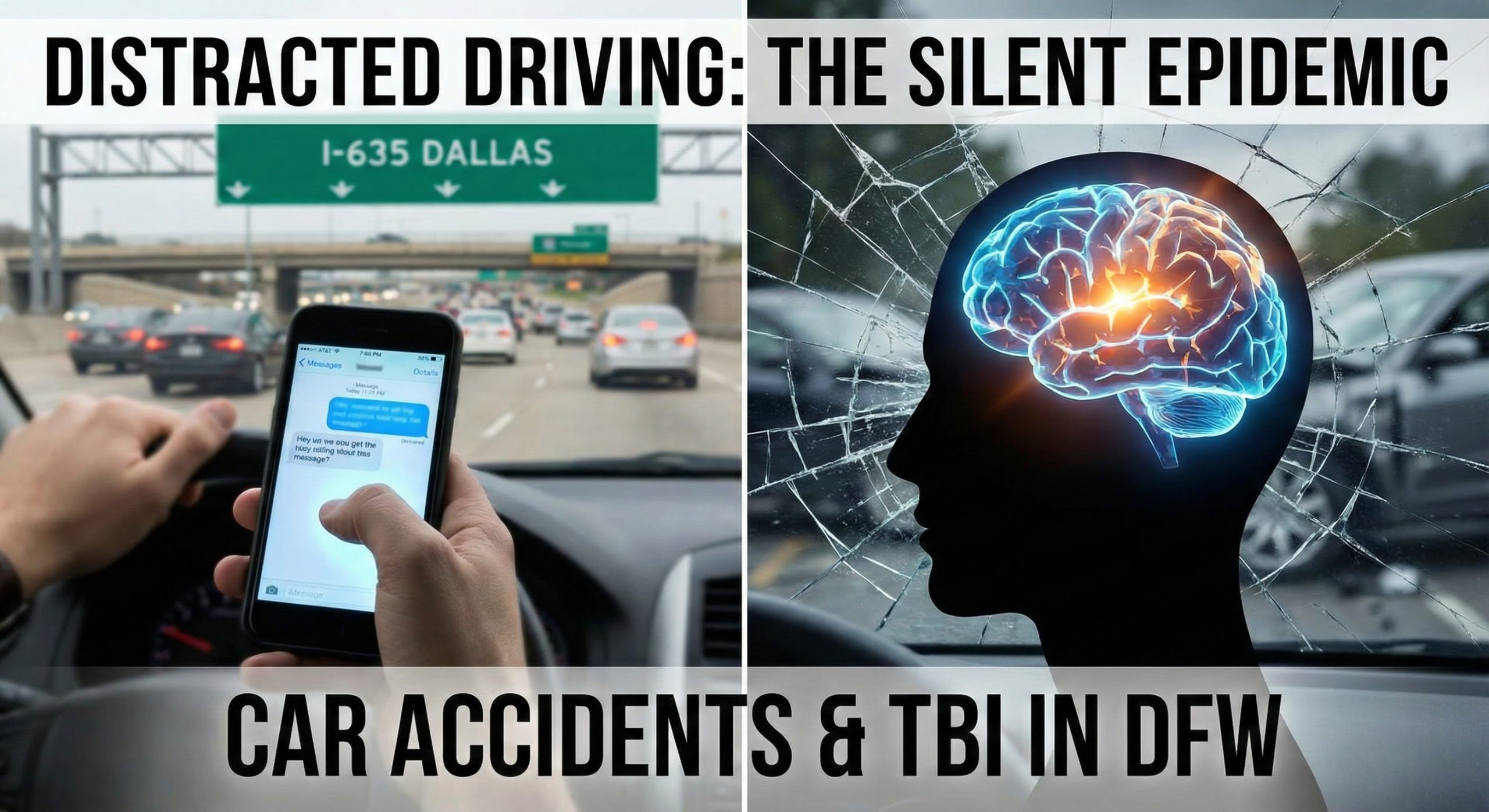
Glancing at a phone for even a moment while driving on crowded routes in the Dallas Fort Worth area can have devastating consequences. Distracted driving is more than a risky habit. It is a widespread factor in serious crashes and a growing contributor to traumatic brain injuries. What seems like a quick text check or notification glance can lead to a collision that leaves lasting and often invisible effects, including cognitive fog, memory issues, mood changes, and emotional distress.
Using recent TxDOT reporting and medical insights, this guide explains how distracted driving increases the risk of traumatic brain injury in Dallas Fort Worth, highlights where distraction-related crashes tend to concentrate across the metroplex, and outlines the legal implications under Texas statutes. The goal is to help readers understand the stakes, recognize the potential signs of injury, and make safer choices that protect drivers, passengers, and families on some of Texas’s busiest roads.
Distracted driving involves any activity diverting attention from the road—texting, eating, or adjusting the radio—leading to delayed reactions and crashes. In Texas, it’s a pressing concern, with laws like Transportation Code Section 545.4251 banning handheld device use in school zones and for novice drivers, yet broader prohibitions lag (source).
Having pondered the human cost, distractions amplify dangers on Texas’s expansive highways. The Texas Department of Transportation reports that in 2024, distracted driving caused nearly one in five crashes, resulting in 373 deaths and 2,587 serious injuries—a trend persisting into 2025 with partial data showing continued high incidence (source). Nationally, the Centers for Disease Control and Prevention links distractions to thousands of traumatic brain injury cases annually from vehicle accidents.
In DFW, urban density worsens this, with commuters facing constant temptations. Based on local patterns, the rise in app distractions underscores why education and enforcement are vital, aligning with Texas’s push for safer roads.
Visual distractions take eyes off the road, like glancing at GPS. Manual ones involve hands leaving the wheel, such as eating. Cognitive distractions divert mental focus, like conversations. Texting combines all three, increasing crash risk 23-fold per studies.
Distracted drivers react slower, missing critical cues like braking lights, leading to collisions. In DFW’s traffic, this often results in rear-ends or intersections crashes, where sudden impacts jolt the brain. Traumatic brain injury ensues from the head striking objects or rapid motion causing shear forces, as explained by the National Institute of Neurological Disorders and Stroke (source).
A momentary glance away can turn a routine drive on Central Expressway into tragedy. Data notes over 91,000 distracted crashes in Texas in 2024, many involving injuries like traumatic brain injury. The mechanism: distraction delays braking by 1.5 seconds, enough at highway speeds to cause severe jolts.
Traumatic brain injury severity varies, classified by Glasgow Coma Scale: mild (13-15), moderate (9-12), severe (3-8), with distractions often leading to high-impact results.
Distractions cause erratic maneuvers, amplifying collision forces. Rotational impacts twist the brain, leading to diffuse axonal injury—torn nerve fibers impairing function (source).
DFW hotspots for distracted driving crashes include I-635 and Skillman Street, with high volumes per TxDOT’s Traffic Safety Data Portal (source). Loop 12 in southern Dallas remains deadly, with 2024 data showing 17 fatalities, trends continuing into 2025 (source).
Partial 2025 insights from Orange Law indicate over one-third of Dallas crashes involve distractions, often mobile-related. Fort Worth’s West 7th Street sees pedestrian risks from distracted drivers.
In these areas—busy intersections like Griffin and Elm—highlight where vigilance is key. TxDOT’s portal shows distracted crashes as a top factor in serious injuries, potentially including traumatic brain injury (source).
TxDOT’s 2024 stats (extending patterns to 2025) reveal 91,000 distracted crashes statewide, with DFW contributing heavily. Serious injuries, including potential traumatic brain injury, numbered 2,800, emphasizing urban hotspots’ dangers (source).
Symptoms include headaches, dizziness, nausea, and confusion immediately, or delayed like memory issues and mood swings. The Centers for Disease Control and Prevention categorizes these as physical, cognitive, and emotional.
In DFW crashes, victims might experience sensitivity to noise or light, impacting daily life. Linking to our delayed symptoms article, awareness aids early intervention.
Mild: Brief confusion, headaches. Severe: Prolonged coma, paralysis. Glasgow Coma Scale guides assessment.
Texas bans texting while driving statewide since 2017, with fines up to $200 under Transportation Code Section 545.4251 (source). Violations prove negligence in claims, per Civil Practice and Remedies Code Section 33.001 for comparative fault (source).
The two-year statute under Section 16.003 applies, with discovery for delayed traumatic brain injury (source). Punitive damages possible for gross negligence, like repeated distractions (source).
In courtrooms, evidence like phone records strengthens cases. Minimum insurance (30/60/25) may not cover severe traumatic brain injury, necessitating UM/UIM.
Subpoena phone records, witness testimony, or accident reconstruction. Texas Rules of Evidence require reliable proof.
Settlements range $252,000-$850,000 for moderate traumatic brain injury in 2025 Texas data, severe exceeding $5 million. Distracted cases often higher due to negligence.
Examples: $4.8 million for truck crash traumatic brain injury. Factors include medical costs, lost wages under Chapter 41 (source).
Severity, economic losses, fault degree. Caps on non-economic damages at $250,000 per claimant.
Use hands-free devices, pull over for tasks. TxDOT campaigns promote awareness (source). Apps block texts while driving.
In hotspots, extra caution: no multitasking. Education under Texas Penal Code for reckless behavior deters (source).
If symptoms appear, visit facilities like UT Southwestern. Document for claims; two-year limit applies (statute article).
Distractions lead to crashes with forces causing brain jolts, resulting in injury; 2025 data shows high DFW incidence.
I-635 & Skillman, Loop 12, per TxDOT 2025 trends.
Loop 12, downtown intersections like Griffin & Elm.
Yes, high speeds from distractions amplify rotational forces leading to axonal tears.
$100,000-$500,000, depending on impacts.
Distracted driving in Dallas-Fort Worth fuels car accidents leading to traumatic brain injury, with 2025 hotspots like I-635 underscoring the peril. From mechanics of injury to symptoms and Texas legal implications—like bans and negligence proofs—awareness drives change. Choosing focus over distraction saves more than time—it preserves futures. Stay informed, drive safely, and seek guidance if affected, honoring the resilience of our Texas communities.
Disclaimer: This blog is for informational purposes only and does not constitute legal advice. Past results do not guarantee future outcomes. For personalized counsel, contact Ted B. Lyon & Associates.
Co-sponsored with myLawCLE, Jeff Grell of Ted Lyon Law and Kevin P. Roddy of Wilentz,… Read More
Recognizing TBI Symptoms After Accidents in Texas Being involved in a car accident in Texas… Read More
Traumatic Brain Injury Compensation Claims in Texas Explained A traumatic brain injury (TBI) can profoundly… Read More
Texas Statute of Limitations for Car Accident Lawsuits After a car accident in Texas, victims… Read More
Understanding Comparative Negligence Laws in Texas Car Accidents Car accidents in Texas can be complex,… Read More
Long-Term Effects of Traumatic Brain Injuries and Legal Options in Texas A traumatic brain injury… Read More

