



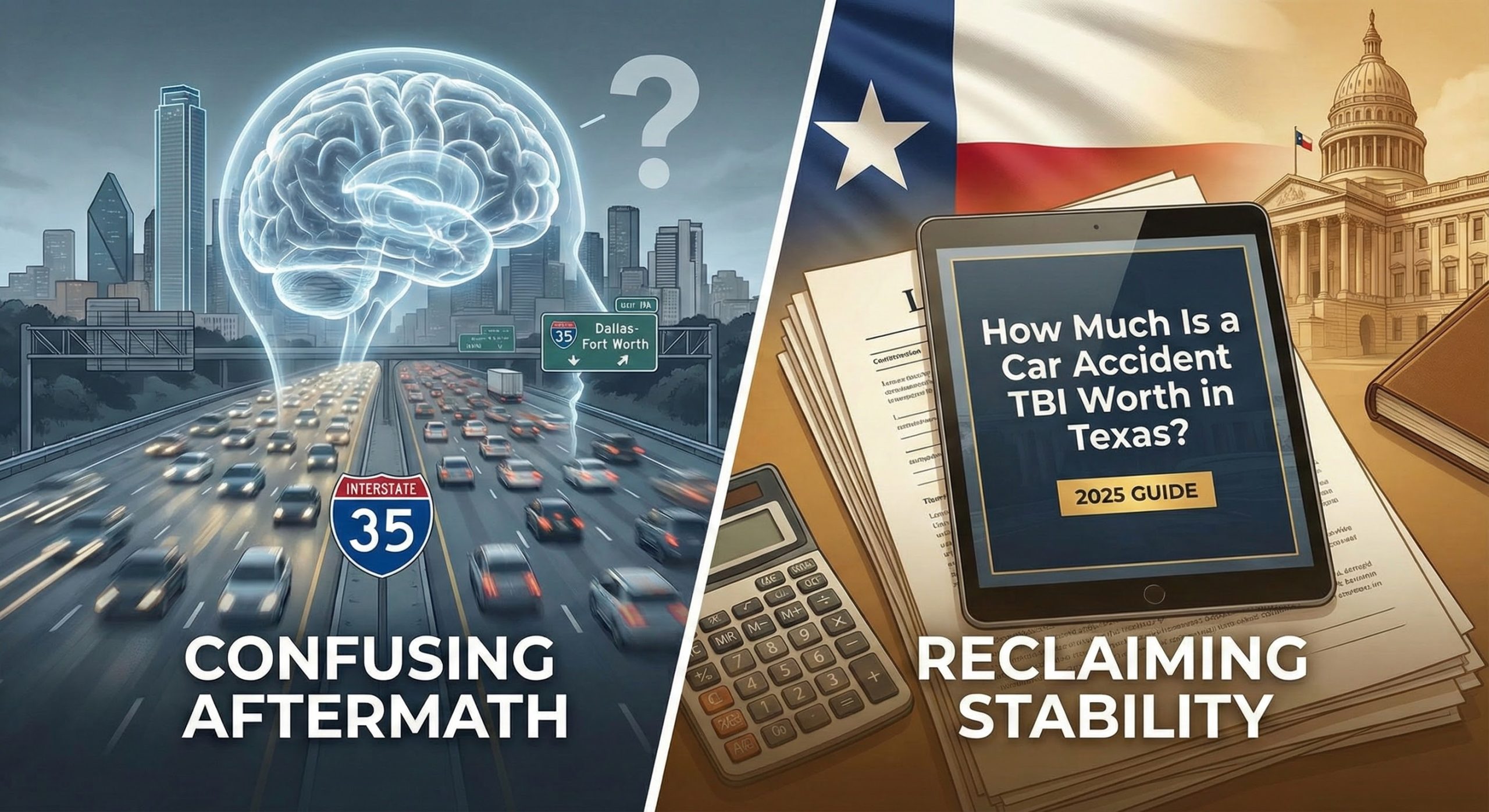
After a car accident on a heavily traveled Dallas Fort Worth corridor such as Interstate 35, people dealing with the aftermath of a traumatic brain injury often ask the same difficult question: what is the case actually worth. The answer is rarely just a dollar figure. It is tied to restoring stability in the face of medical expenses, time away from work, ongoing treatment needs, and the less visible impact on daily functioning, relationships, and emotional well-being. Traumatic brain injuries can change lives in profound ways, and understanding how compensation is evaluated under Texas law can provide a clearer starting point for pursuing a fair outcome.
This 2025 guide reviews how traumatic brain injury claims are commonly valued in Texas, including typical settlement ranges, illustrative case outcomes, and the key factors that influence compensation. The goal is to provide clarity in plain language so readers can better understand what drives value in these cases while focusing on recovery.
Understanding Damages in Texas Car Accident Traumatic Brain Injury Cases
In Texas, compensation for traumatic brain injury from car accidents falls into economic, non-economic, and sometimes punitive categories, as defined in the Civil Practice and Remedies Code Chapter 41 (source). Economic damages cover tangible losses like medical expenses—from emergency care at hospitals like Parkland Memorial to ongoing therapy—and lost wages, crucial in a region where many rely on driving for livelihoods.
Non-economic damages address the intangible, such as pain, suffering, and diminished life quality. Texas caps these at $250,000 per claimant against non-healthcare providers, or up to $750,000 in some scenarios, but economic losses have no limit. Punitive damages punish egregious acts, like a distracted driver causing the crash, capped at twice economic plus non-economic up to $750,000 or $200,000, whichever greater.
These categories capture the full impact: a mild injury might mean short-term rehab, while severe could require lifelong support. Texas’s modified comparative fault rule in Section 33.001 reduces awards if you’re over 50% at fault, emphasizing evidence collection (source).
Economic vs. Non-Economic Damages Explained
Economic: Quantifiable, like $100,000+ in hospital stays for severe traumatic brain injury. Non-economic: Subjective, compensating for daily struggles like memory loss affecting family roles.
Key Factors Influencing the Value of a Car Accident Traumatic Brain Injury Claim in Texas
Severity is paramount, assessed by tools like the Glasgow Coma Scale—lower scores indicate higher potential awards due to extensive care needs. Age and occupation matter: a young professional in DFW’s tech sector might claim more for future earnings loss under Labor Code provisions for impairment benefits if work-related (source).
Negligence level affects outcomes; a drunk driver violating Penal Code Section 49.04 could lead to punitive additions (source). Insurance coverage caps recovery, while strong evidence—medical records, witnesses—bolsters claims.
Local factors like DFW’s traffic density on I-20 increase collision risks, influencing jury sympathy in courts like Dallas County District. Delayed symptoms complicate valuation, but the discovery rule in Section 16.003 may extend filing time (source).
The Role of Severity and Medical Evidence
Severe cases with coma or paralysis yield higher values; mild, like concussions, lower. Medical affidavits under Section 18.001 prove costs (source).
Average Settlement Amounts for Car Accident Traumatic Brain Injury in Texas (2025 Data)
Based on 2025 analyses, average settlements for traumatic brain injury from car accidents in Texas range from $540,000 overall, with mild cases $100,000-$500,000, moderate $252,000-$850,000, and severe over $1 million, drawn from verdict research and public records. Jury Verdict Research notes Texas personal injury verdicts average $826,892, with traumatic brain injury often higher due to long-term impacts.
In DFW, urban medical costs push figures up; a Brain Injury Association of America report highlights lifetime expenses exceeding $3 million for severe cases (source). These averages fluctuate with case specifics, but provide benchmarks for expectations.
Mild vs. Moderate vs. Severe Traumatic Brain Injury Averages
Mild: $20,000-$100,000 for short recovery. Moderate: $252,000-$850,000 including therapy. Severe: $1-$5 million+ for lifelong care.
Real 2025 Settlement and Verdict Examples from Texas Car Accident Traumatic Brain Injury Cases
Public records show varied outcomes. In Harris County, a 2025 jury awarded $56 million to a hit-and-run victim with permanent traumatic brain injury, covering impairments in memory and communication (source).
Another example: $4.9 million settlement for a trucking accident causing severe traumatic brain injury, addressing personality changes and skills loss (source). A Lubbock County case yielded $1,230,000 for negligence-related treatment leading to injury.
A $831 million verdict in Texas for an intoxicated driver crash underscores potential when gross negligence is proven. These illustrate how evidence and circumstances drive values in courts across the state.
Notable DFW-Area Examples
While specific DFW verdicts vary, patterns mirror statewide: multimillion awards for severe cases involving negligence, per judicial branch overviews (source).
How Texas Law Affects Traumatic Brain Injury Compensation in Car Accident Cases
Texas’s at-fault system requires proving negligence, often via Transportation Code violations like speeding (source). Caps in Chapter 41 limit non-economic damages, but not economic or future care (source).
The two-year statute in Section 16.003 pressures timely action, with tolling for minors or incapacity (source). Comparative fault reduces if over 50% responsible. Uninsured motorist coverage under Insurance Code helps if at-fault lacks insurance (source).
These laws balance protection and accountability, but navigating requires thorough documentation.
Impact of Comparative Fault on Settlements
If 20% at fault, award reduces 20%; over 50%, none. Juries assess based on evidence.
Challenges in Valuing and Proving Car Accident Traumatic Brain Injury Cases
Invisible injuries challenge proof; neuropsychological tests and experts are essential under Rules of Evidence. Insurance often downplays, but records counter.
In DFW, high crash rates per Texas Department of Transportation data complicate causation (source). Delayed symptoms invoke discovery rule, extending timelines.
Overcoming Insurance Denials
Appeal with medical proof; Texas Department of Insurance oversees fairness (source).
Steps to Maximize Your Car Accident Traumatic Brain Injury Claim in Texas
- Seek immediate medical evaluation.
- Document symptoms and expenses.
- Gather accident evidence.
- Understand statutes like two-year limit.
Link to statute guide.
FAQ: Common Questions About Car Accident Traumatic Brain Injury Values in Texas
What is the average settlement for a mild traumatic brain injury from car crash in Texas?
$100,000-$500,000, depending on recovery.
How does Texas fault rule affect my car accident traumatic brain injury claim?
Comparative fault reduces if partially responsible; over 50%, barred.
What tests prove invisible brain damage after auto accident?
Neuropsychological evaluations and functional assessments.
Is mild traumatic brain injury from car crash worth hiring a lawyer in Texas?
Yes, for navigating complexities and maximizing value.
How much is a traumatic brain injury settlement from a car accident in Texas?
Averages $252,000-$850,000 for moderate; higher for severe.
Conclusion
Valuing a car accident traumatic brain injury in Texas involves weighing damages, factors like severity, and laws like caps and statutes. With 2025 examples showing millions in awards, understanding provides a path forward. Knowledge empowers recovery—focus on facts, document diligently, and know your rights under Texas law.
Disclaimer: This blog is for informational purposes only and does not constitute legal advice. Past results do not guarantee future outcomes. For personalized counsel, contact Ted B. Lyon & Associates.