
Rear-End Collisions and Traumatic Brain Injury: Why Even Low-Speed Crashes Cause Serious Brain Injuries in Texas
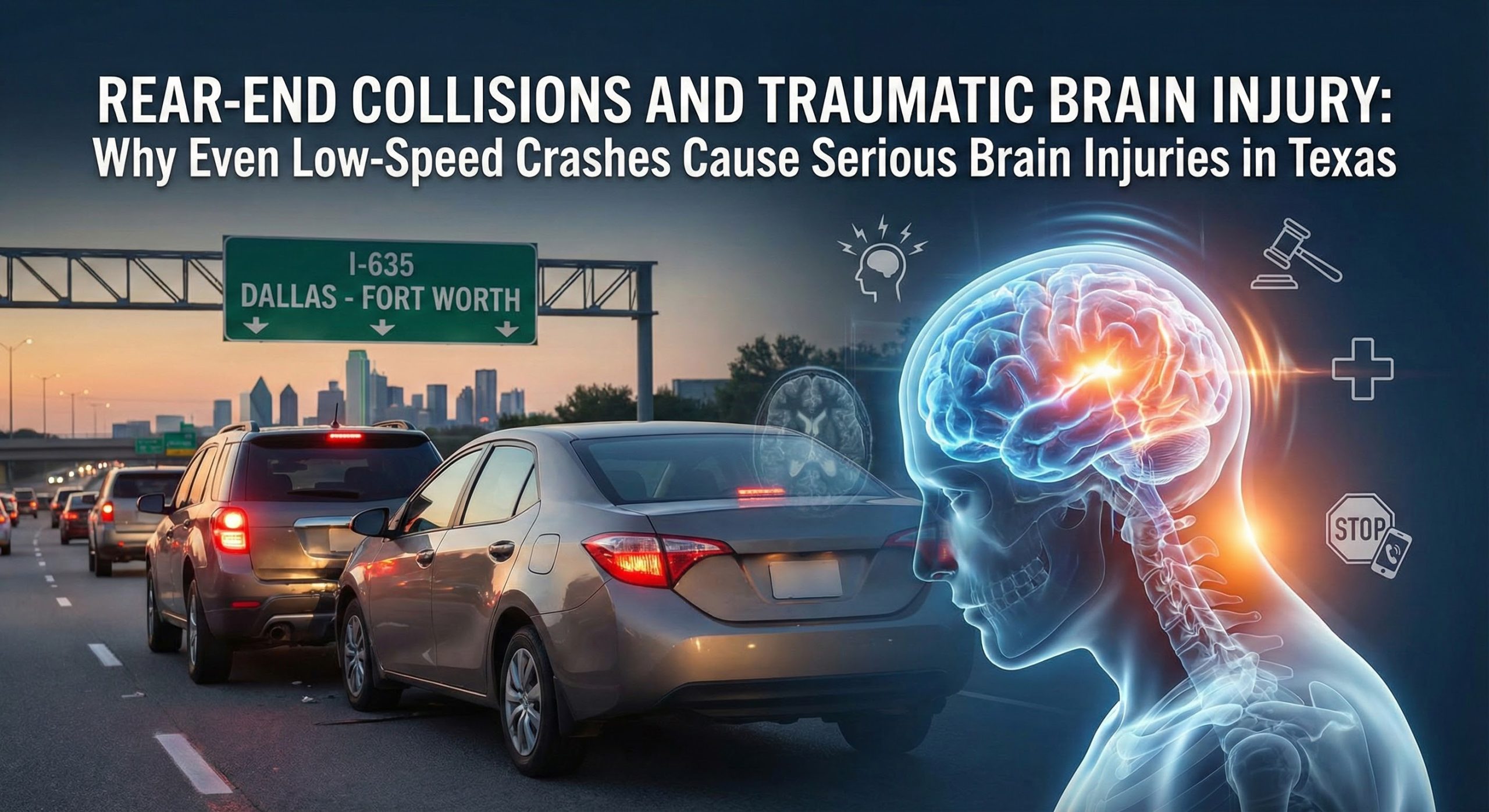
Rear-end collisions often happen in everyday traffic, including at red lights and stop-and-go congestion throughout the Dallas Fort Worth area. Even when the impact seems minor, these crashes can carry hidden risks, including the possibility of traumatic brain injury. What may initially appear to be a simple fender-bender can later develop into lingering headaches, cognitive fog, dizziness, mood changes, or other symptoms that disrupt daily life and work.
Grounded in medical insights and Texas-specific context, this guide explains why even low-speed rear-end crashes can cause serious harm, what warning signs to monitor, and how Texas law may apply when injury leads to medical bills, missed work, or long-term complications. The goal is to help readers understand the risks, recognize symptoms early, and take informed steps toward appropriate care and any legal remedies that may be available.
What Are Rear-End Collisions and Why Are They So Common in Texas?
Rear-end collisions occur when one vehicle strikes the back of another, often due to following too closely, distraction, or sudden stops. In Texas, these crashes are alarmingly frequent, contributing to a significant portion of roadway incidents. According to the Texas Department of Transportation, while specific 2025 data is emerging, patterns from 2023 show over 4,283 fatalities and 18,752 serious injuries statewide, with rear-end collisions playing a key role in urban areas like Dallas-Fort Worth.
With the chaos of Texas highways, factors like heavy traffic on I-35 or Loop 12 exacerbate risks. Nationally, rear-end crashes account for about 31% of all car accident injuries, as reported by safety analyses. In the Lone Star State, where vast interstates meet urban congestion, tailgating—prohibited under Texas Transportation Code Section 545.351—often leads to these events (source).
Distracted driving, such as texting, further fuels the issue, with penalties under Section 545.4251 aiming to deter but not always preventing tragedies. Dallas’s deadliest roads like Loop 12 see repeated incidents, highlighting why awareness is crucial for drivers navigating DFW’s sprawl.
Statistics on Rear-End Collisions in Dallas-Fort Worth
In DFW, hotspots like I-635 and Skillman Street average high crash volumes, with rear-ends prominent due to stop-and-go traffic. Recent insights indicate that while overall fatalities dipped slightly by 2025, serious injuries from such collisions remain steady, per ongoing Texas Department of Transportation monitoring (source). These stats underscore the deceptive safety of “minor” crashes, where invisible injuries lurk.
How Rear-End Collisions Cause Traumatic Brain Injury
In a rear-end collision, the rapid forward-then-backward motion—known as whiplash—can slam the brain against the skull’s interior, causing bruising, tearing, or swelling. Even without direct head impact, this acceleration-deceleration force disrupts neural connections, leading to traumatic brain injury. The Centers for Disease Control and Prevention notes that motor vehicle crashes are a leading cause, with rear-ends contributing significantly.
From a thoughtful standpoint, it’s the physics that deceives: the vehicle’s crumple zones absorb energy, but the brain doesn’t have such protection. In Texas, where truck-involved rear-ends amplify forces, the risk escalates. Medical reviews confirm that whiplash often underlies these injuries, with symptoms emerging delayed (source).
Common scenarios include stopped vehicles hit from behind, where the occupant’s head snaps violently. This can result in diffuse axonal injury, shearing nerve fibers, even in non-fatal crashes.
The Mechanics of Whiplash and Brain Damage
Whiplash stretches neck muscles and ligaments, but the brain’s movement within cerebrospinal fluid creates shear stress. Studies show this can lead to micro-hemorrhages invisible on initial scans (source). In low-speed cases, the lack of visible vehicle damage often misleads, but internal harm persists.
Why Low-Speed Rear-End Crashes Still Pose Serious Risks for Traumatic Brain Injury
Contrary to intuition, low-speed crashes—under 10 mph—can still inflict traumatic brain injury through subtle forces. Research on volunteer impacts reveals that even minor jolts cause brain motion sufficient for injury (source). In Texas, where minimum insurance covers $30,000 per person under Insurance Code Chapter 601, these “minor” incidents often underestimate long-term needs (source).
Some insurance adjusters dismiss low-damage claims, yet medical evidence from sources like Johns Hopkins shows whiplash can trigger concussions or worse (source). Factors like head position or pre-existing conditions amplify risks, making every crash potentially serious.
In DFW’s traffic, stationary vehicles at lights are vulnerable, with studies indicating low-speed rear-ends lead to musculoskeletal and brain issues (source).
Risks in Specific Low-Speed Scenarios
Parking lot bumps or slow freeway stops can cause whiplash-induced traumatic brain injury. Elderly or child passengers face heightened vulnerability, as Texas data on pediatric traumatic brain injury suggests (source).
Common Symptoms of Traumatic Brain Injury from Rear-End Collisions
Symptoms may appear immediately or delay, including headaches, dizziness, nausea, and confusion. Cognitive issues like memory loss or concentration difficulties follow, per Centers for Disease Control and Prevention guidelines.
Emotional changes—irritability or depression—and sensory sensitivities emerge. Linking to our delayed symptoms guide, monitoring is essential.
Delayed vs. Immediate Symptoms
Immediate might include loss of consciousness; delayed, post-concussion syndrome with chronic pain. Texas Health and Human Services notes these can persist months (source).
Legal Implications of Traumatic Brain Injury from Rear-End Collisions in Texas
In Texas, rear-end drivers are often presumed at fault under Transportation Code Section 545.062 for following distance (source). However, comparative negligence in Civil Practice and Remedies Code Section 33.001 can reduce awards if shared fault (source).
The two-year statute under Section 16.003 applies, with discovery rule for delayed diagnoses (source). Proving low-speed traumatic brain injury requires medical experts, as Texas Rules of Evidence demand.
With court dynamics, juries in Dallas County often sympathize with invisible injuries when evidenced well. Uninsured motorist coverage helps if at-fault driver lacks insurance.
Proving Fault and Injury in Low-Speed Cases
Police reports, witness statements, and biomechanical experts prove causation. For invisible traumatic brain injury, neuropsychological tests are key (source).
Average Settlements for Traumatic Brain Injury from Rear-End Collisions in Texas
Settlements vary: mild traumatic brain injury might yield $20,000-$100,000, moderate $252,000-$850,000, severe over $1 million in 2025 data. Rear-end specifics show $100,000-$500,000 for severe cases.
Recent examples: $850,000 for commercial rear-end traumatic brain injury. Factors include medical bills, lost wages, and pain under Civil Practice and Remedies Code Chapter 41 (source).
Factors Influencing Settlement Amounts
Severity via Glasgow Coma Scale, economic losses, and negligence level affect outcomes. Punitive damages possible for gross negligence like DUI under Penal Code Section 49.08 (source).
When to Seek Medical and Legal Help After a Rear-End Collision
Seek care if symptoms arise, even delayed. In DFW, facilities like Baylor offer diagnostics. Legally, document everything; two-year clock ticks, but tolling for incapacity under Section 16.001 (source).
Resources: Brain Injury Network of Dallas. Link to settlement guide.
FAQ: Common Questions About Traumatic Brain Injury from Rear-End Collisions in Texas
Can a rear-end collision cause traumatic brain injury?
Yes, through whiplash; even low-speed impacts can result in serious brain injuries, with settlements often exceeding $100,000 in Texas.
Can you get traumatic brain injury from a low-speed car accident?
Absolutely; research shows minor jolts cause whiplash leading to traumatic brain injury, often invisible on initial scans.
What is the average payout for concussion from car wreck in Fort Worth?
Averages $20,000-$100,000 for mild cases, higher for persistent symptoms in Texas settlements.
Can whiplash lead to traumatic brain injury legally in Texas?
Yes, whiplash is recognized as a mechanism for traumatic brain injury in claims, provable with medical evidence.
What should I do if insurance denies my car accident traumatic brain injury claim?
Gather expert testimony and appeal; Texas law allows challenging denials for invisible injuries.
Conclusion
Rear-end collisions in Texas, deceptive in their “minor” appearance, can inflict serious traumatic brain injury through mechanisms like whiplash, even at low speeds. From the common symptoms—headaches to cognitive shifts—to the legal pathways under statutes like the two-year limitations period, awareness is your ally. Prompt action in seeking medical and legal guidance can transform outcomes. By understanding these risks and rights, you position yourself not just to recover, but to thrive beyond the crash.
Disclaimer: This blog is for informational purposes only and does not constitute legal advice. Past results do not guarantee future outcomes. For personalized counsel, contact Ted B. Lyon & Associates.