



If you’ve recently been in a car accident on a busy Dallas-Fort Worth highway like Interstate 35, or suffered a fall at a construction site in Tarrant County, you might be wondering if that lingering headache is just a concussion or something more serious like a traumatic brain injury. The distinction isn’t just medical—it’s crucial in Texas personal injury law, where how your injury is classified can significantly influence the outcome of your claim. Misunderstanding this difference could mean the difference between receiving adequate compensation for your medical bills and lost wages or facing an uphill battle in court. In this guide, we’ll explore the nuances between concussion and traumatic brain injury, drawing from reliable sources and Texas statutes, to help you navigate these challenging waters with confidence.
What Is a Concussion? Understanding the Basics
A concussion is often described as a mild form of brain injury caused by a bump, blow, or jolt to the head that disrupts normal brain function temporarily. According to the Centers for Disease Control and Prevention, concussions typically result from falls, sports injuries, or motor vehicle accidents, leading to symptoms like headaches, dizziness, and confusion that usually resolve within days to weeks (source).
In the Dallas-Fort Worth area, where traffic congestion and urban activities heighten risks, concussions are common in everyday scenarios. For instance, a rear-end collision on Loop 820 might cause your head to snap forward, resulting in this type of injury. While many recover fully, some experience lingering effects, highlighting why early medical evaluation is essential.
From a personal standpoint, I’ve seen how what starts as a “simple” concussion can evolve, affecting daily life in unexpected ways. It’s not just about the immediate pain but the potential for subtle changes in concentration or mood that linger, impacting work and relationships in a fast-paced region like ours.
Symptoms and Diagnosis of Concussions
Common symptoms include nausea, sensitivity to light or noise, and temporary memory loss. Diagnosis often involves a physical exam and cognitive tests, as standard imaging like computed tomography scans may not detect these mild injuries, per the National Institute of Neurological Disorders and Stroke (source).
In Texas, healthcare providers at facilities such as Baylor Scott & White Health use guidelines from the Texas Department of State Health Services to assess and manage these cases, ensuring comprehensive care (source).
What Is Traumatic Brain Injury? A Broader Perspective
Traumatic brain injury encompasses a range of brain damages from mild to severe, caused by an external force. Unlike a concussion, which is at the mild end, traumatic brain injury can involve penetrating injuries or severe contusions leading to long-term disabilities, as defined by the Centers for Disease Control and Prevention (source).
In Texas, with its high rate of vehicle accidents—over 500,000 reported in 2023 according to the Texas Department of Transportation—traumatic brain injury affects thousands annually (source). Severe cases might result from high-impact crashes on highways like the Dallas North Tollway, causing swelling, bleeding, or even coma.
Reflecting on the broader impact, traumatic brain injury doesn’t just heal with rest; it often requires ongoing rehabilitation, reshaping lives in profound ways. In a community as diverse as Dallas-Fort Worth, this can mean navigating cultural and economic challenges alongside physical recovery.
Symptoms and Diagnosis of Traumatic Brain Injury
Symptoms vary by severity: mild cases mirror concussions, while moderate to severe include loss of consciousness, persistent confusion, or physical impairments. Diagnosis may involve magnetic resonance imaging or the Glasgow Coma Scale, a tool scoring injury severity from 3 to 15, where lower scores indicate worse prognosis (source).
Texas law recognizes these distinctions in personal injury claims, influencing how damages are calculated under the Civil Practice and Remedies Code Chapter 41 (source).
Key Differences Between Concussion and Traumatic Brain Injury
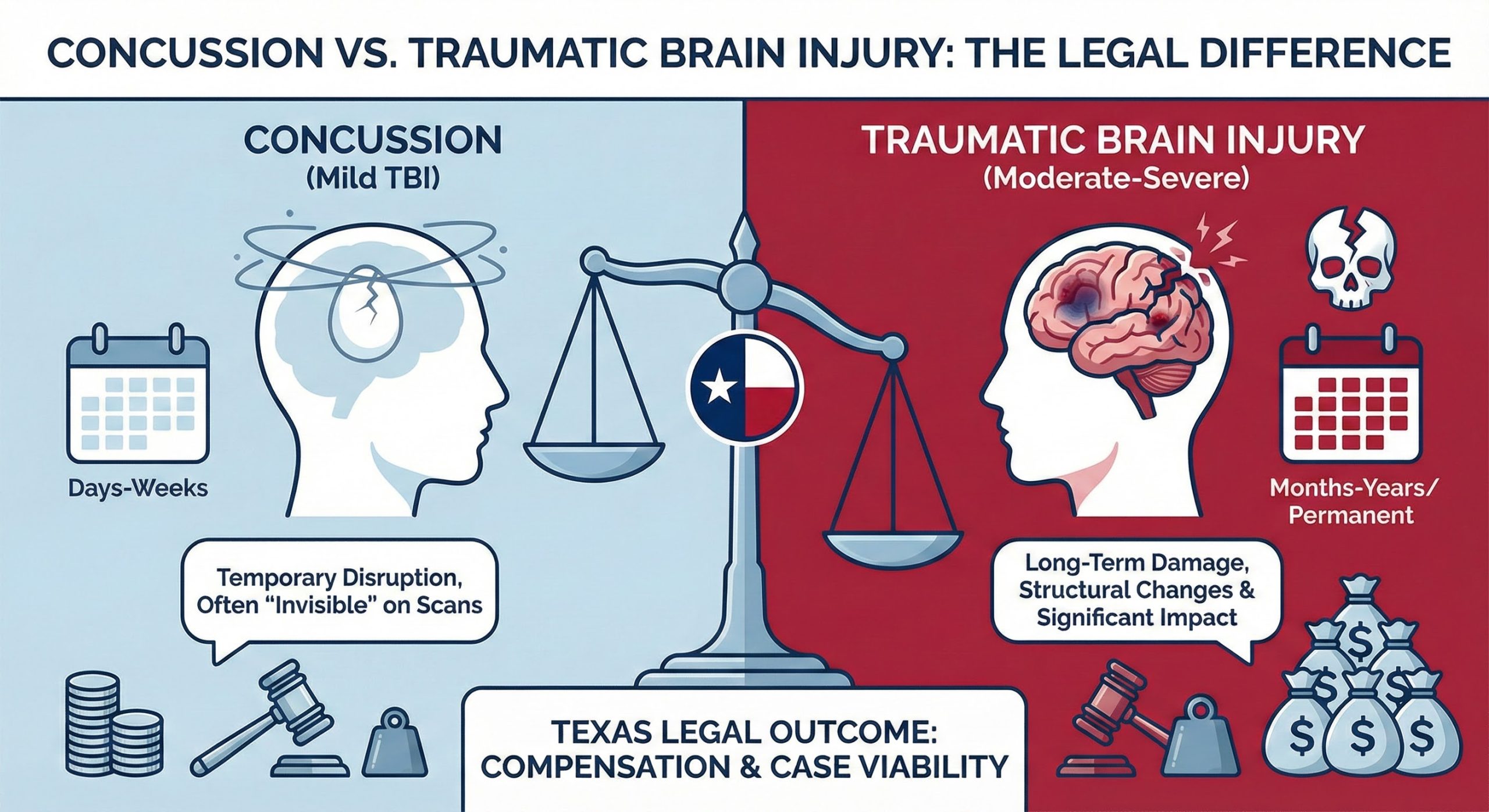
While all concussions are technically traumatic brain injuries, the reverse isn’t true. Concussions are mild and often resolve without permanent damage, whereas traumatic brain injury can be moderate or severe, leading to lasting effects like cognitive deficits or personality changes, as explained by Johns Hopkins Medicine (source).
The duration of symptoms is a major differentiator: concussions typically last 7-10 days, but traumatic brain injury can persist for months or years. Structurally, concussions don’t usually show on imaging, while severe traumatic brain injury might reveal bruising or bleeding.
In my view, this overlap creates confusion, especially in legal contexts where proving the extent of injury is key. A “concussion” label might downplay severity, but evidence can reveal it’s part of a broader traumatic brain injury spectrum.
Medical Classification Using the Glasgow Coma Scale
The Glasgow Coma Scale helps classify: scores of 13-15 indicate mild (often concussion), 9-12 moderate, and 3-8 severe traumatic brain injury. This scale is pivotal in medical and legal assessments, guiding treatment and compensation evaluations in Texas courts (source).
Legal Implications: How the Difference Affects Your Texas Personal Injury Case
In Texas personal injury law, distinguishing between concussion and traumatic brain injury can determine case viability and compensation. Under the Civil Practice and Remedies Code Section 16.003, you have two years to file, but severity influences damage awards (source).
Mild concussions might yield lower settlements, averaging $20,000-$50,000, while severe traumatic brain injury can exceed millions, covering economic and non-economic damages capped at $250,000 per claimant under Chapter 41 (source).
Proving negligence—such as a driver violating Texas Transportation Code Section 545.401 on reckless driving—is essential (source). The modified comparative fault rule in Section 33.001 reduces awards if you’re partially at fault (source).
From experience, cases hinge on medical documentation; a concussion evolving into post-concussion syndrome can elevate claims, emphasizing thorough records.
Proving Invisible Injuries in Court
“Invisible” injuries like concussions or mild traumatic brain injury lack clear scans, requiring neuropsychological tests and expert testimony under Texas Rules of Evidence (source). In Dallas-Fort Worth, experts from UT Southwestern can bolster cases (source).
Challenges in Dallas-Fort Worth Personal Injury Claims Involving Brain Injuries
Local challenges include insurance disputes minimizing concussions as “minor.” High traffic in areas like downtown Dallas increases incidents, per Texas Department of Transportation data (source).
Workers’ compensation under Texas Labor Code Chapter 408 covers job-related injuries but limits suits against employers (source). Third-party claims remain viable.
Navigating these requires understanding Texas Constitution Article 1 protections for due process (source).
Steps to Take If You Suspect a Concussion or Traumatic Brain Injury
- Seek immediate medical attention at facilities like John Peter Smith Hospital.
- Document symptoms and treatments meticulously.
- Preserve accident evidence, linking to our Dallas page for local insights.
- Monitor for worsening symptoms, as delays can complicate claims.
Early action aligns with Texas’s discovery rule, potentially extending filing periods.
FAQ: Common Questions About Concussion vs Traumatic Brain Injury in Texas Cases
Is a concussion considered a traumatic brain injury under Texas law?
Yes, concussions are mild traumatic brain injuries, impacting how damages are assessed in personal injury claims.
How does the Glasgow Coma Scale affect my case?
It classifies severity, influencing compensation; lower scores often lead to higher awards for long-term care.
What if my injury doesn’t show on scans?
Invisible injuries can be proven with functional tests and expert witnesses, crucial for Texas evidence standards.
Can a concussion turn into a traumatic brain injury?
Concussions are traumatic brain injuries; untreated, they can lead to post-concussion syndrome with lasting effects.
What’s the statute of limitations for brain injury claims in Texas?
Generally two years, per Civil Practice and Remedies Code Section 16.003.
Conclusion
Distinguishing between concussion and traumatic brain injury is more than semantics—it’s fundamental to pursuing fair outcomes in Texas personal injury cases. In Dallas-Fort Worth, where accidents are commonplace, awareness of these differences empowers individuals to address their injuries effectively. By understanding medical and legal nuances, you can better advocate for your recovery, ensuring no detail is overlooked in the pursuit of justice.
Disclaimer: This blog is for informational purposes only and does not constitute legal advice. Past results do not guarantee future outcomes. For personalized counsel, contact Ted B. Lyon & Associates.