



If you’ve endured a severe traumatic brain injury from a high-speed collision on Interstate 35 in Dallas or a workplace fall in Fort Worth’s bustling warehouses, the road to recovery can feel overwhelming, both emotionally and financially. As someone who’s seen the profound challenges families face in Texas—where over 144,000 people sustain traumatic brain injuries annually according to the Texas Department of State Health Services—the question of who covers the staggering costs of rehabilitation and long-term care is paramount. These expenses can soar into millions over a lifetime, straining resources and futures. This guide explores the realities of life post-injury, drawing from Texas statutes and reliable data, to shed light on financial avenues without adding to your burden. Understanding these options can provide a semblance of stability in uncertain times.
Understanding Severe Traumatic Brain Injury and Its Long-Term Impacts
Severe traumatic brain injury occurs when a violent blow or jolt to the head causes extensive brain damage, often leading to prolonged unconsciousness or coma, as classified by a Glasgow Coma Scale score of 3-8 per the Centers for Disease Control and Prevention (source). In Texas, common causes include motor vehicle accidents and falls, contributing to the state’s high incidence rate, with approximately 381,000 residents living with related disabilities, based on estimates from the Brain Injury Association of America (source).
The long-term effects can be life-altering: cognitive impairments like memory loss, physical challenges such as paralysis, and emotional issues including depression. Reflecting on cases I’ve encountered, these changes don’t just affect the individual—they ripple through families, altering dynamics in homes across Dallas-Fort Worth. Daily activities become hurdles, and independence may require assistive devices or constant care, underscoring the need for comprehensive support systems.
From a broader view, severe traumatic brain injury disrupts employment, with many unable to return to work, exacerbating financial strain. Texas Labor Code Chapter 408 recognizes this through workers’ compensation provisions for ongoing medical needs if job-related (source). Awareness of these impacts is the first step toward navigating recovery.
Common Challenges in Daily Life After Severe Traumatic Brain Injury
Post-injury, simple tasks like cooking or driving may become impossible, leading to reliance on caregivers. Emotional volatility can strain relationships, while chronic pain adds physical tolls. In urban Texas settings like Dallas-Fort Worth, accessing specialized care amid traffic and distance poses additional hurdles, as noted in reports from the North Central Texas Council of Governments on healthcare accessibility (source).
The Financial Burden: Estimating Costs of Rehab and Long-Term Care in Texas
The economic impact of severe traumatic brain injury is staggering, with lifetime costs ranging from $85,000 for mild cases to over $3 million for severe, according to the Centers for Disease Control and Prevention (source). In Texas, where medical expenses are influenced by urban-rural divides, initial hospitalization alone can exceed $100,000, followed by rehabilitation averaging $8,000 to $12,000 monthly at facilities like those in the Texas Health and Human Services network (source).
Long-term care—encompassing home modifications, therapy, and assisted living—adds layers, with annual costs potentially reaching $50,000 or more, per data from the Brain Injury Association of America (source). Reflecting personally, I’ve observed how these figures translate to real struggles: families in Fort Worth dipping into savings or facing debt, highlighting the urgency of identifying funding sources early.
Texas-specific factors, like higher costs in Dallas-Fort Worth due to demand, amplify this. A study in PLOS One on in-hospital costs post-severe traumatic brain injury reports ranges from $2,130 to $401,808 globally, with U.S. figures trending higher (source). Planning involves anticipating these, from acute rehab to lifelong support.
Breaking Down Cost Categories for Traumatic Brain Injury Care
Costs divide into acute care (emergency and hospital stays), rehabilitation (physical, occupational therapy), and long-term (home care, medications). In Texas, Medicaid data shows significant expenditures on these, with home health aides costing $20-$30 hourly (source). Assistive devices add thousands annually, emphasizing comprehensive budgeting.
Who Pays for Rehabilitation After a Severe Traumatic Brain Injury in Texas?
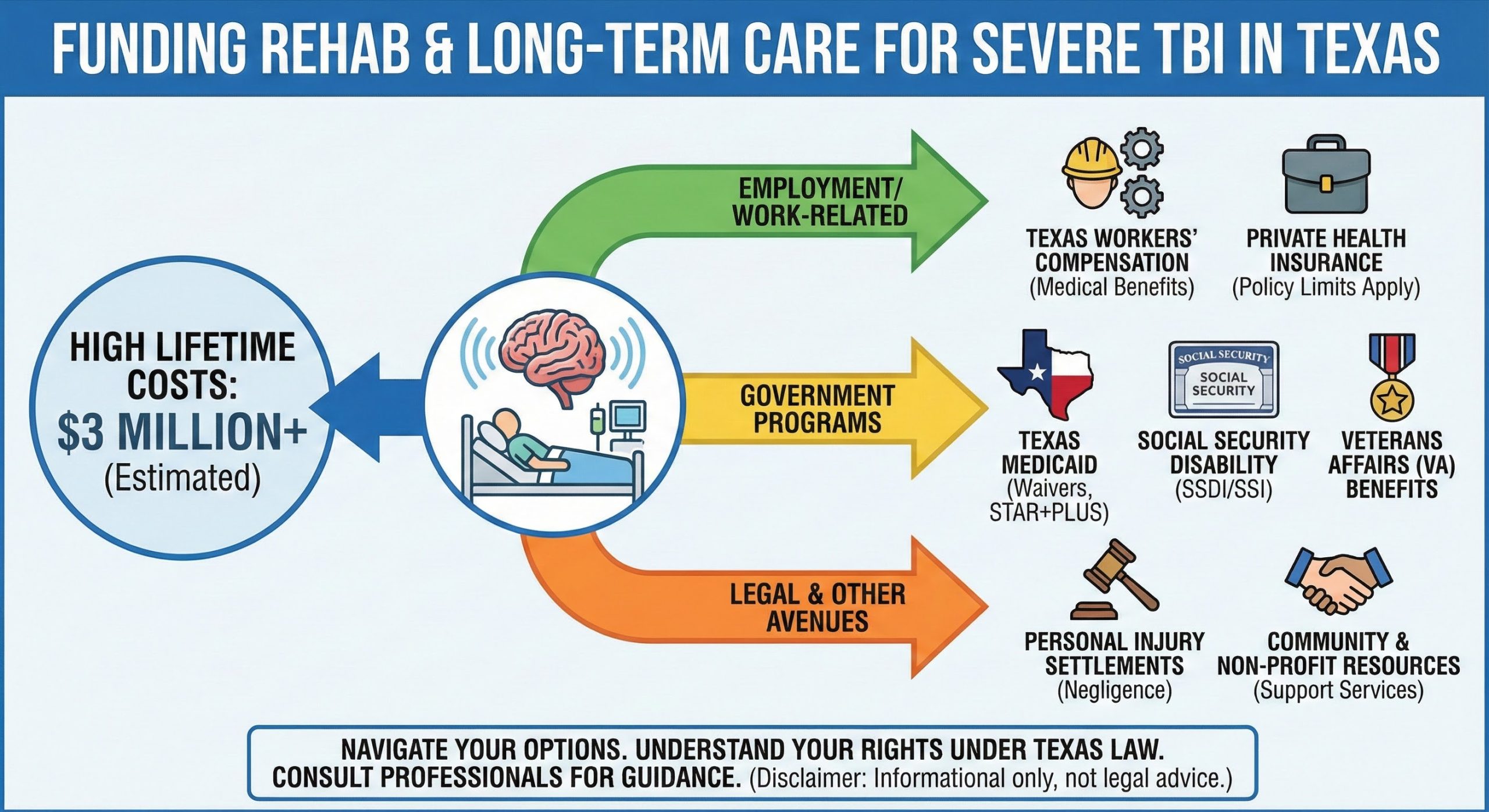
Rehabilitation—crucial for regaining function—involves multidisciplinary therapy, often covered by various payers in Texas. Private health insurance typically funds initial phases, but limits apply, as outlined in the Texas Insurance Code Chapter 1201 (source). For uninsured or underinsured, the Texas Health and Human Services’ Comprehensive Rehabilitation Services program assists those with traumatic brain injury, providing inpatient and outpatient services to foster independence (source).
If work-related, Texas workers’ compensation under Labor Code Chapter 408 covers medical benefits, including rehab, without lifetime caps for necessary care (source). From my observations, this is vital in industrial Dallas-Fort Worth, where injuries from falls or machinery are common.
Medicaid, for eligible low-income individuals, funds rehab through waivers like the Home and Community-based Services for traumatic brain injury, ensuring access to therapy (source). Veterans may access specialized programs via the U.S. Department of Veterans Affairs, with up to 100% coverage for service-connected traumatic brain injury (source).
Navigating Insurance Coverage for Traumatic Brain Injury Rehab
Private insurers often require pre-authorization, with coverage varying by policy. Texas law mandates certain mental health parity under Insurance Code Chapter 1355, which can extend to cognitive rehab (source). Challenges arise with denials, but appeals are possible, supported by Texas Department of Insurance resources (source).
Options for Funding Long-Term Care in Texas
Long-term care for severe traumatic brain injury—spanning years—involves home health, assisted living, or nursing facilities. Costs in Texas average $50,000-$100,000 annually, per Texas Health and Human Services long-term care data (source).
Medicaid is a primary payer for eligible individuals, covering nursing home care and community-based services via programs like STAR+PLUS, which integrates long-term services for those with disabilities (source). Eligibility requires meeting income thresholds, typically 300% of Supplemental Security Income levels.
Social Security Disability Insurance and Supplemental Security Income provide monthly benefits if traumatic brain injury meets listing 11.18 criteria, including disorganization of motor function or marked limitations in functioning (source). In Texas, these can fund care, with average monthly SSDI at $1,300.
For veterans, VA benefits include long-term care through community living centers or home-based primary care, especially for service-connected conditions (source). Personal injury settlements, governed by Texas Civil Practice and Remedies Code Chapter 41, can also cover costs if negligence is proven, though caps apply to non-economic damages (source).
Reflecting on this, blending these sources often forms the safety net, but gaps persist, particularly for middle-income families.
Texas-Specific Programs for Long-Term Traumatic Brain Injury Support
The Acquired Brain Injury program under Texas Health and Human Services offers case management and resources for independence (source). Community Resource Coordination Groups facilitate interagency support, addressing holistic needs (source).
Challenges in Accessing Care in Dallas-Fort Worth
In Dallas-Fort Worth, urban sprawl and provider shortages complicate access, with waitlists for specialized rehab at facilities like UT Southwestern (source). Transportation barriers, amid high crash rates per Texas Department of Transportation (source), add hurdles.
Economic disparities mean lower-income areas face longer waits for Medicaid services. Linking to local insights on our Dallas page, community organizations like the Brain Injury Network of Dallas bridge gaps (source).
From a personal lens, these challenges test resilience, but knowledge of rights under the Texas Constitution Article 1 for equal access empowers advocacy (source).
Steps to Secure Funding for Your Care
- Document your injury thoroughly with medical records.
- Apply for relevant programs promptly, like Medicaid via Your Texas Benefits (source).
- Explore workers’ comp if applicable, under Labor Code guidelines.
- Consider SSDI/SSI applications through Social Security Administration (source).
- Seek veteran-specific aid if eligible via VA (source).
These steps, aligned with Texas processes, facilitate access.
FAQ: Common Questions About Funding Rehab and Long-Term Care for Traumatic Brain Injury in Texas
What is the average cost of long-term care for severe traumatic brain injury in Texas?
Lifetime costs can exceed $3 million, with annual figures around $50,000-$100,000, per CDC estimates.
Does Texas Medicaid cover traumatic brain injury rehab?
Yes, through waivers and programs like Comprehensive Rehabilitation Services for eligible individuals.
How does workers’ compensation handle long-term traumatic brain injury care in Texas?
It covers medical benefits indefinitely if necessary, including rehab, under Labor Code Chapter 408.
Are VA benefits available for traumatic brain injury in Texas?
Yes, up to 100% disability rating for service-connected traumatic brain injury, funding care.
Can Social Security Disability help with traumatic brain injury costs?
Yes, if meeting listing criteria, providing monthly income for care expenses.
Conclusion
Life after a severe traumatic brain injury in Texas presents formidable challenges, but understanding funding sources—from Medicaid and workers’ compensation to VA and Social Security—offers pathways to support. In Dallas-Fort Worth, where incidents are prevalent, this knowledge fosters resilience. By grasping these options rooted in Texas law, individuals and families can focus on healing, knowing financial avenues exist to ease the journey.
Disclaimer: This blog is for informational purposes only and does not constitute legal advice. Past results do not guarantee future outcomes. For personalized counsel, contact Ted B. Lyon & Associates.